Essay
Energy, Not Time
By Noah Isaacs · Last updated
Almost every productivity system starts from the same rule: manage your time. Block the calendar, protect your mornings, count the hours.
While well intentioned and helpful on the margins, I think the rule is aimed at the wrong thing. The constraining factor for most of the CEOs I coach isn’t time. The bottleneck is energy, and energy doesn’t behave like time. An hour is always an hour. An hour of the right work can leave you with more in the tank than you started with, and an hour of the wrong work can flatten the rest of your day.
The idea isn’t new. Harvard Business Review ran “Manage Your Energy, Not Your Time” back in 2007. What I think has been missing is the part you can act on. Your energy has a structure. The work that drains you usually lights someone else up. And a team’s energy has a shape you can design on purpose.
Energy Elevation is a free, two-minute assessment I built to measure that: where your energy peaks and drains across six altitudes of work, from the 30,000-foot view to the ground. If you want, take it now and read the rest with your own curve in front of you.
Energy has an altitude
If energy is the constraint, the useful question is where yours comes from. My answer is that it has an altitude.
Every project runs from the 30,000-foot view, where the big questions live, down to the ground, where the thing actually gets finished. Most people come alive somewhere along that range and fade somewhere else. Whether you’re a morning person matters less than the kind of work in front of you.
I noticed it in myself first. Give me a hard question about where a business should go, or a stack of options to judge, and I can go all day. Ask me to chase ten people for updates and finish the last ten percent of a project, and I’m empty by lunch. I can do both. Only one of them gives anything back.
Three stages, six altitudes
Every project has to answer three questions, in order. What could we do? Will we do it? Did we do it?
Each question takes two kinds of work. Someone has to mind it, paying close attention to what’s actually there. Someone has to move it, putting something new into the world. The three questions run from high altitude to low, and with two moves each they give you six altitudes. In each pair below, the first minds and the second moves.
You can’t skip a stage. An idea doesn’t become work without a decision and people who commit to it, and in my experience the middle is where most projects stall. The bottom also loops back to the top, because finishing one thing usually shows you the next gap.
Companies loop the same way. In the Strategic Scorecard I describe moving from Rallying Cry to Rallying Cry, which Richard Rumelt calls moving from proximate objective to proximate objective. Achieving one should expand your opportunity space for what’s possible next. That starts a new round at high altitude, back at the top of the curve.
The six aren’t separate jobs. Each one takes the move above it as its input, so it’s easiest to see in one project, top to bottom. Say a startup keeps losing customers in their third month.
High altitude: what could we do?
- Inquiring (30,000 ft) minds the gap. Someone stops treating churn as normal and asks: why do so many customers quit in month three?
- Inventing (25,000 ft) moves an answer onto the table. That question is the brief. Someone comes back with three ways to fix it: a kickoff call for every new account, a setup checklist inside the product, or a cheaper starter plan.
Mid altitude: will we do it?
- Evaluating (20,000 ft) minds the options. Three ideas are useless until someone picks. Someone notices that the customers who quit never finished setup, so the kickoff call is the one worth betting on.
- Marshaling (15,000 ft) moves people to commit. A choice nobody acts on is just an opinion. Someone gets customer success and sales to run the call for every new account starting Monday, and checks every week that it’s happening.
Low altitude: did we do it?
- Supporting (10,000 ft) minds what people need. Now the reps are doing something new. Someone writes the call script, fixes the scheduling link, and answers their questions so nobody gets stuck.
- Finishing (the ground) moves it across the line. The reps do the calls themselves, every new account on their list, including the awkward last few who keep rescheduling, until every call is done and logged.
And the finish shows the next gap. The calls work, but they eat a week of the team’s time every month. Could setup run itself? That’s a new question at 30,000 feet, and the loop starts again.
The assessment asks about each of those six moves. You react to moments like “Looking for the weak point in a plan everyone else is excited about” or “Following up to make sure people did what they said they would do,” and your answers draw your curve.
Read those slowly. A couple will pull at you, and a couple will push you away. Your top two and your bottom two combine into one of 15 profiles. Reading them is fun, but picking your own from a list is hard. Which one is yours? It takes two minutes to find out.
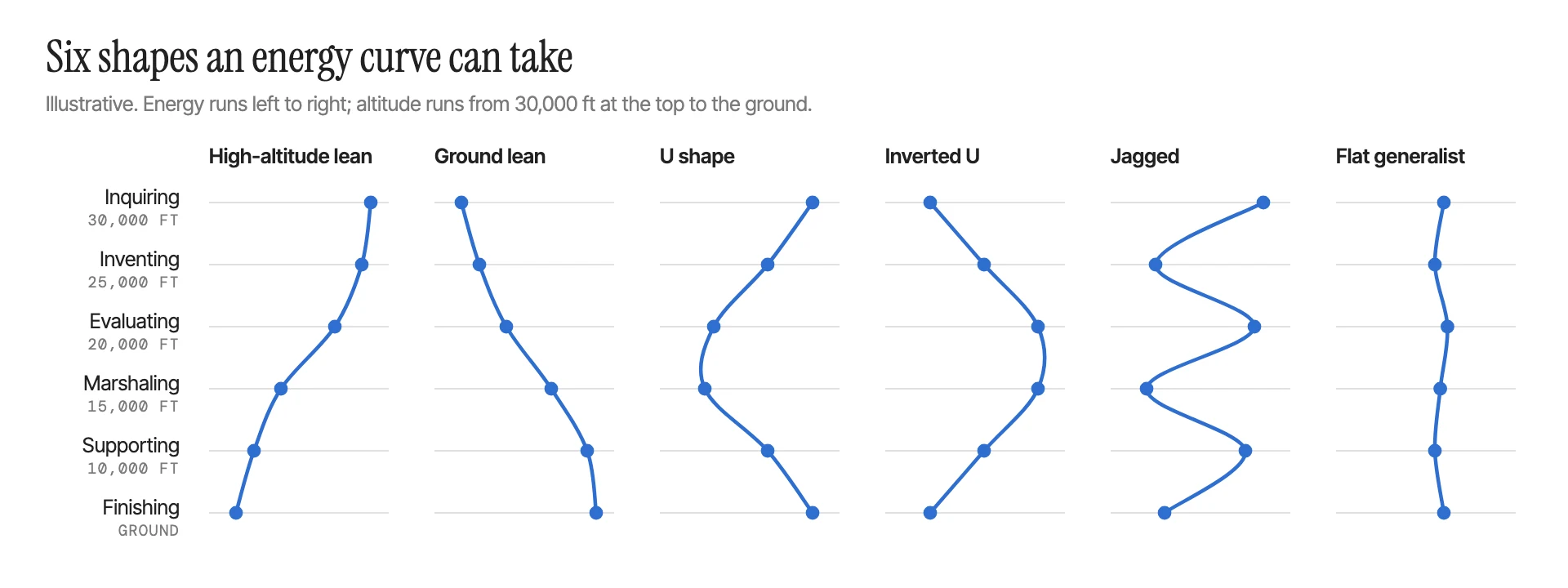
The same six altitudes can describe very different people. Where the curve peaks matters, and so does how steep it is and where it dips. And a curve doesn’t have to be smooth. The altitudes are in order, but your energy doesn’t have to follow that order. Plenty of people are high on Inquiring, low on Inventing, and high again on Evaluating. A jagged curve isn’t a bad result. It just tells you exactly which hand-offs you need from other people.
Where this departs from Working Genius
If this sounds like Patrick Lencioni’s Working Genius, it should. I’ve recommended it to many CEOs, and his six types map closely onto these six altitudes. I’m not trying to replace it. I built this because there were things I needed Lencioni’s framework to tell me that it couldn’t.
First, Working Genius puts everyone into the same boxes: two geniuses, two competencies, two frustrations. That’s a packaging choice, not a finding. Two people with the same top two can be wildly different in how strong those are.
Second, it throws away the shape. A curve shows how high your energy runs, how sharply it peaks, and where it dips. Some people peak at the very top and the very bottom and sag in the middle. In a box model that just looks like a confusing mix. On a curve it’s a clear, recognizable person.
Third, it tells you to cover all six types on a team, but not what a healthy team actually looks like. I think it has a shape, and I’ll get to it below.
Built to be answered honestly
Every self-assessment has the same trap: aspirational answers. Some answers describe what everyone wants, or who everyone wants to be. Ask whether shipping a project energizes you and almost everyone says yes, because who doesn’t want it shipped? A question like that measures nothing.
So every card asks about the work, not the result. “Supporting” was the hardest one to get right, because it’s the most aspirational. Being helpful is a virtue, so people rate it high to feel like a good person. I did too. My first Supporting score came back at 94, and my gut said the 70s. The cards now describe the actual labor of helping, like fielding questions all day from people who are stuck.
It runs in two passes. First you react to each moment on its own: energizes, neutral or drains. Then you make a few head-to-head choices, only between things you rated the same. How it works has the detail if you want it.
Teams have a shape
Work at high altitude is leverage. One good question can set the direction for everyone below it, so a little goes a long way. Work on the ground is volume. There’s more of it, it splits across many hands, and it needs real numbers of people to get done.
So my working view is that a healthy team looks like a pyramid: wide at the ground, narrower as you climb, and never empty at any altitude. The two failure shapes are easy to spot once you look. A top-heavy team has more ideas than it will ever ship. A team with a hollow top grinds hard in no particular direction. This is a heuristic I’m still testing, not a law.
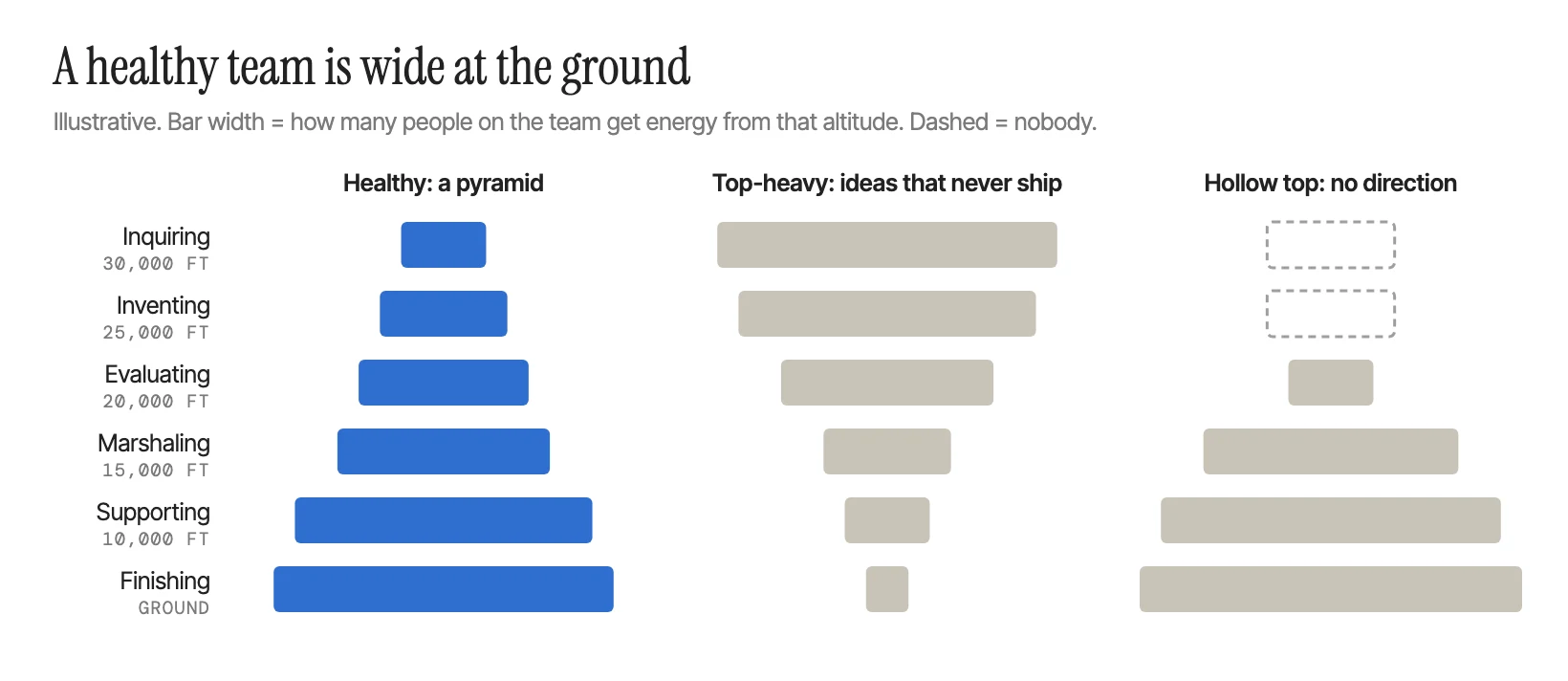
The pyramid also tells you who to work with. Your best partner is usually the person whose energy peaks exactly where yours runs out.
The same thinking applies when part of the team is AI agents, and it starts with a better question: where do you want your agents spending their time? An agent doesn’t run out of energy, so point it at the altitudes that drain you. Picture an engineer who freezes at a blank page but loves judging a draft and closing tickets. Let an agent take the first pass, and their day moves to Evaluating and Finishing, where their energy lives. Someone who drains at the finish can hand the last mile to an agent instead. Your curve is a map of where agents will help you most.
The same goes for a team. Agents can fill whatever altitude your people leave thin, at the top or the bottom, and someone still has to mind what they produce. Swarms of agents fail in the same shapes as teams. A top-heavy swarm plans and brainstorms forever and never ships. A swarm with a hollow top grinds through tasks with nobody asking whether they were the right ones. So give a swarm at least one agent at every altitude, including one that asks whether it’s solving the right problem and one that judges what the others produce.
Every role has a curve
The same logic goes for hiring. A role’s mission sets the curve it needs. The title doesn’t.
Take two Heads of Sales. The first joins a seed-stage company to find the first sale that repeats. There’s no playbook yet, so the job is asking why deals close and inventing the motion. That’s Inquiring and Inventing. The second joins at Series B to scale a motion that already works. The job is holding a team to the playbook and closing the quarter. That’s Marshaling and Finishing. Both are great sales leaders, and each would be miserable in the other’s job.
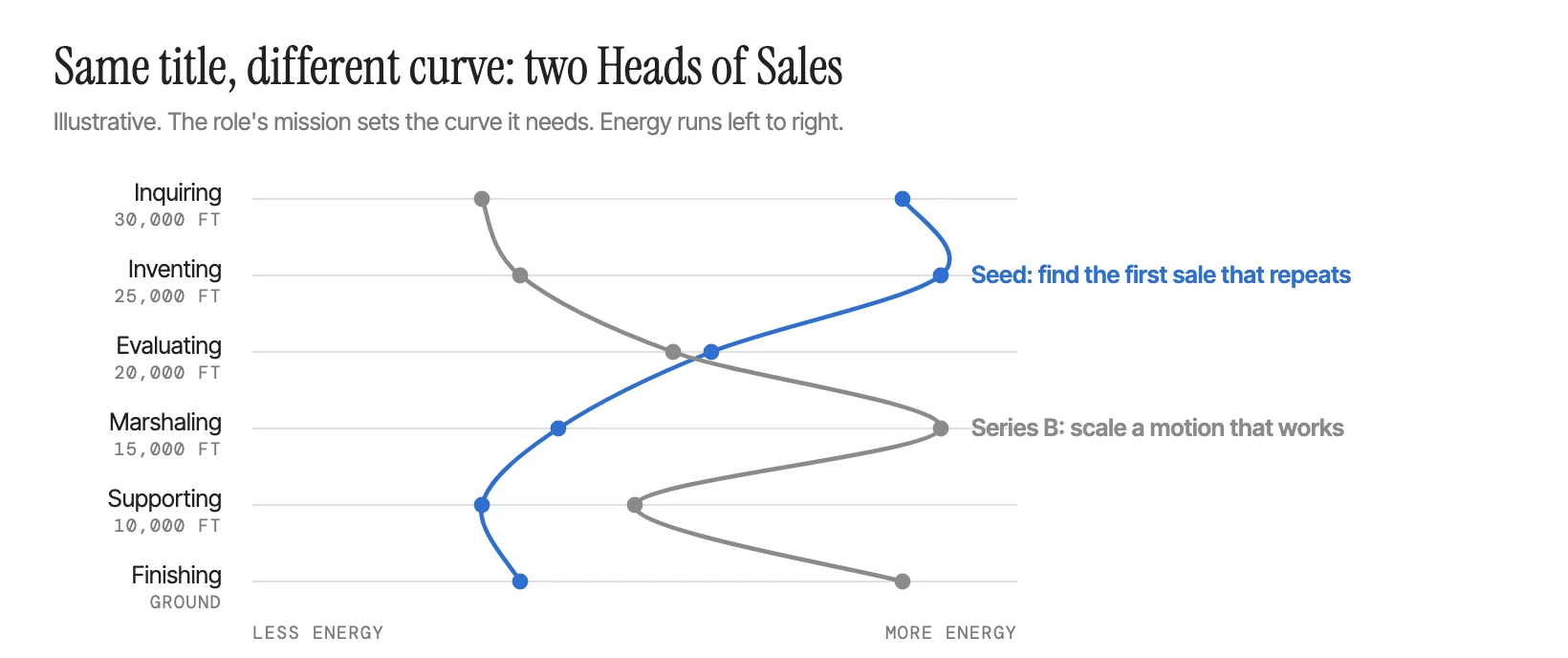
Here’s a common version. A strong operator gets promoted into a strategy role. Their skills didn’t change, but the mission moved to the part of the curve where their energy drains, and six months later people wonder what happened to them. What happened is the job moved to their valley.
So when you write the scorecard for a role, draw its curve too. Which altitudes does the mission demand, and which can sit low because the rest of the team covers them? Then compare the candidate’s curve to the role’s, and to your team’s gaps. I wrote about building the rest of that scorecard in The Talent Scorecard.
Meetings have an altitude too
This also explains a lot of bad meetings. People pull a meeting toward the altitude where they get energy and away from where they lose it.
Picture a tactical meeting about shipping a launch everyone has already agreed to, and someone asks, “Should we even be doing this?” At the right time, that’s one of the most valuable questions in the company. After the decision, it drags the whole room back up to 30,000 feet. It happens the other way too. In a strategy meeting about where the company should go, someone gets into implementation details, and nobody can see the big picture anymore.
Nobody’s doing it to be difficult. They’re drifting toward where their energy lives. The fix is to name the meeting’s altitude before it starts, in the invite: a high-, mid- or low-altitude meeting. “This is a low-altitude meeting: we’re shipping the launch, not revisiting it.” When someone pulls the room up or down, anyone can point to the invite. The good question goes on a list for the right meeting instead of taking over this one.
What to do Monday
- For yourself: protect your peak, and hand your valleys to the people they lift. When you delegate, cost still matters: start with whose time the work is worth. Among the people it makes sense for, give it to the one it lifts.
- For your team: put your curve in your user manual (an essay on writing one is coming soon), and compare curves before you split up the next project.
- For your next hire: draw the role’s curve before you write the job description.
- For your next meeting: put its altitude in the invite (high, mid or low).
You can’t make more hours. You can get more out of the ones you have by spending them at the altitudes that give you the most energy.
Take Energy Elevation. It takes about two minutes. Then invite your team and see its shape. And if that shape worries you, or you’re about to hire into it, I’m happy to talk it through.
Questions
What is Energy Elevation?
Energy Elevation is a free, two-minute assessment that shows where your energy peaks and drains across six altitudes of work, from the 30,000-foot view to the ground. You react to 24 moments at work, make a few head-to-head choices, and get your curve by email, with a team view to compare curves.
What are the six altitudes of work?
Inquiring (30,000 ft) and Inventing (25,000 ft) answer what could we do. Evaluating (20,000 ft) and Marshaling (15,000 ft) answer will we do it. Supporting (10,000 ft) and Finishing (the ground) answer did we do it. In each pair, the first minds what's there and the second moves something new into the world.
Should you manage your energy or your time?
Energy. An hour is always an hour, but an hour of the right work can leave you with more in the tank than you started with, and an hour of the wrong work can flatten the rest of your day. What decides which is which is the altitude of the work.
How is Energy Elevation different from Working Genius?
Patrick Lencioni's Working Genius maps closely onto the same six areas, and I've recommended it to many CEOs. Energy Elevation keeps the whole curve instead of sorting everyone into two geniuses, two competencies and two frustrations, so it shows how strong each peak is, where you dip, and what a healthy team looks like.
How do you tell if a candidate fits a role's energy?
Draw the role's curve before you write the job description: which altitudes does its mission demand, and which can sit low because the rest of the team covers them? Then compare the candidate's curve to the role's and to your team's gaps. A seed-stage Head of Sales and a Series B one need different curves.
Is the Energy Elevation assessment free, and how long does it take?
Yes, it's free and takes about two minutes. You swipe through 24 moments at work, make up to eight head-to-head choices, and your result comes by email from [email protected]. From there you can start a team, send the link, and see everyone's curves side by side.
One hour. One problem.
Bring the thing that is keeping you up at night. You will leave with a point of view on it either way.
Get in touch